

Former tax inspector Amit Puri explains how the HMRC’s Customer Compliance Group is structured and outlines the roles of its front- line staff.
As someone familiar with HMRC’s vast frontline operational resources I wanted to highlight that structure, so readers better understand what enquiries from the various directorates and teams at HMRC might be about.
These directorates are large and span the whole of the UK geographically. They collectively sit within HMRC’s Customer Compliance Group. All the teams making up its underlying directorates carry out compliance checks/enquiries, more serious tax investigations, manage taskforces and campaigns, encourage and handle various tax disclosures, and lead HMRC’s risk assessing function.
The vast majority of HMRC’s approximately 28,000 frontline staff is organised within the Customer Compliance Group, operating since 2016-2017 after restructuring the former Enforcement and Compliance group.
There are six core directorates: Individuals and Small Business Compliance; Wealthy and Mid-sized Business Compliance; Fraud Investigation Service; Counter Avoidance; Large Business; and Risk & Intelligence Service. They are responsible for routine enquiries, serious tax investigations, taskforces/ campaigns and tax disclosures, and lead HMRC’s risk assessing function.
In 2024-25, total compliance yield was £149 billion. Chances are that all compliance/non-routine letters come from this part of HMRC, so it’s useful to recognise it.
The Customer Compliance Group
The Customer Compliance Group (CCG) was established in the second half of 2016 and fully formed by September 2017, after a major restructure to the previously known of ‘Enforcement and Compliance’ group.
While the Civil Service’s website has long stated that the CCG was made up of over 26,000 people, several articles seen in 2025 reported that the figure for 2024/25 was 28,074. That makes it almost half of HMRC’s entire headcount.
Prominent directorates within HMRC’s CCG:
- Fraud Investigation Service (FIS)
- Individuals and Small Business Compliance (ISBC)
- Wealthy and Mid-sized Business Compliance (WMBC)
- Counter Avoidance (CA)
- Large Business (LB)
- Risk & Intelligence Service (RIS)
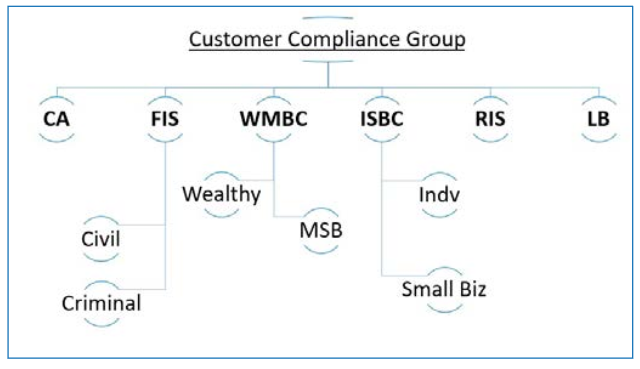
Fraud Investigation Service
The most in-depth and intrusive investigations, both civil and criminal in nature, are managed by HMRC’s Fraud Investigation Service (FIS). These are not routine compliance checks/enquiries like those carried out by the two main directorates (see below).
The FIS directorate comprises a large number of front-line investigative resource, but many readers are unlikely to have come across them before. As per figures obtained under a Freedom of Information Act request and as identified online, for the 2024/25 reporting year FIS had maintained its officer numbers at around 5,000.
FIS was formed in 2015 by merging Specialist Investigations (SI), which used to carry out the most serious civil tax investigations like Code of Practice 9 (COP9) and Code of Practice 8 (COP8), and Criminal Investigations (CI).
SI’s focus was on suspicions of tax fraud and dishonesty/evasion, as well as aggressive avoidance, and CI investigated criminal conduct with a view to prosecution and confiscation orders.
These parts of FIS still operate fairly independently for obvious reasons: carefully balancing formal information requests in order to be able to use them in court, and because the legislation and rules pertaining to their operations differ considerably.
Currently, FIS is primarily organised into the following units at the top:
- Prosecutions Unit: focused on criminal investigations and prosecutions.
- UK Tax Matters Unit: handles domestic tax fraud cases.
- Offshore, Corporate, and Wealthy Unit: deals with complex cases involving offshore assets and high-net-worth individuals.
Debt Management: Notably, the Debt Management Unit now sits outside of the CCG, because it is not and has never been operational; in the sense that it does not carry out compliance activities. Readers may have witnessed an uptick in the volume of correspondence from this directorate over the past year or two as many more resources have been moved here (recruited), to help reduce the large debt backlog.
ISBC and WMBC
These large directorates make up the vast majority of CCG and therefore HMRC’s investigative resource at c. 12,400 staff. So the chances are that any enquiry letter received by a reader and/or their client will come from one of these two juggernauts.
Once upon a time they operated as one, under the name of Local Compliance. This takes me back to when I joined the old Inland Revenue!
Large Business
The LB directorate manages around 2,000 of the UK’s largest businesses in terms of their turnovers. Offering a much different and closer relationship to HMRC through its network of Customer Compliance Managers; like relationship managers in the private sector.
Risk & Intelligence Service
The RIS directorate seeks out intelligence from across the UK and offshore; and then analyses this intelligence and assesses the tax risks to the UK.
They manage more and more information streams and analyse bulk data, whether acquired formally, ad hoc or for payment, which has become more prevalent.
They have a great number of personnel on the ground in many countries around that world too, sharing intelligence and practices. RIS has been steadily growing over time, nowadays to around 3,300 staff.
Importantly, from a time when they were producing pre risk-assessed potential cases for operational teams to consider pursuing, and running various projects, they became operational.
Some of the underling teams within it create and run focused taskforces and campaigns. This includes leading tax disclosure facilities like the Let Property Campaign and the Worldwide Disclosure Facility. Where these can be managed within RIS they are, and where there are risks that encourages escalation. So other directorates are then involved or they take over the cases. This is routine.
Counter Avoidance
The CA directorate is charged with using a range of strategies and greatly enhanced and even still legal powers to tackle marketed tax avoidance schemes and arrangements. Their approach focuses both on disrupting promoters and helping the huge number of users getting out of schemes.
It is, however, the smallest directorate within CCG, but their staff regularly lead many other teams in the other directorates. It plays more of a project management role, given the number of different historic schemes out there and the many, many users that have built up over a very long time.
The vastness and complexity of the rules introduced for CA in this space and the powers available to penalise scheme users and promotors has been prolific, some say. Also, the newer legislative measures (a) keep coming (volume), and (b) are being introduced with comparative haste.
Other directorates/teams
Older readers may recall smaller directorates like ‘Specialist Personal Tax’ and ‘Personal Tax International’, for example, which were merged into WMBC over time. They comprised technical support teams like ‘Affluent’, ‘Trusts & Estates’, ‘IHT Compliance’, ‘Residence, Domicile & Remittance Basis’, and ‘Transfer of Assets Abroad’.
This article does not explore the exhaustive list of underlying teams and sub-teams, or other directorates within the CCG, but focuses on the main ones, from which readers and/or their clients are most likely to have received a letter or notice from.
CCG resource numbers
The table below shows the staff numbers (full-time equivalents – FTE) in these core directorates, as of the end of September 2025:
| Directorate | FTE |
| Counter Avoidance | 1,354 |
| Fraud Investigation Service | 4,894 |
| Individuals and Small Business Compliance | 8,374 |
| Large Business | 2,473 |
| Risk and Intelligence Service | 3,309 |
| Wealthy and Mid-sized Business Compliance | 4,025 |
CCG compliance checks and yield secured
We also checked with HMRC as to the performance of the Customer Compliance Group over the past five years, in terms of the number of compliance checks carried out by the directorates within it and the yield secured from those.
| Tax Year | Checks Opened | Checks Completed | Yield (£m) |
| 2020/21 | 247,000 | 248,000 | £23,727 |
| 2021/22 | 265,000 | 256,000 | £23,524 |
| 2022/23 | 299,000 | 280,000 | £27,838 |
| 2023/24 | 311,000 | 320,000 | £34,674 |
| 2024/25 | 332,000 | 316,000 | £39,230 |
*The compliance check figures have been rounded to the nearest thousand
So in 2024-25, on a crude calculation, CCG staff appear to have assured an average of £1.4 million each in compliance yield from their efforts.
This is a very high-level calculation of course and should not be considered as accurate.
HMRC said the number of cases opened and closed by their compliance staff each year were determined by the risk landscape, their strategic priorities and ministerial commitments. Therefore, compliance check numbers are not always a reliable indicator of compliance work undertaken or compliance performance.
However, we are aware that HMRC’s measurement of ‘compliance yield’ includes an estimate of the additional revenue it assumes to have generated or protected through its compliance and enforcement activities. So it’s not just the tax, interest and penalties it collected from direct interventions.
HMRC expanded this point, saying the key performance indicator here included several components that reflected both immediate revenue secured – which the man on the street is likely to most identify with – and future behavioural changes which are all estimated figures. This includes:
- Cash Expected
- Revenue Loss Prevented
- Future Revenue Benefit
- Upstream Product and Process Yield
- Upstream Operational Yield
- Accelerated Payments
CCG Directorates’ underlying teams
We also asked HMRC to expand on the names of the operational teams within the core front-line CCG directorates. Some of their respective work is self-explanatory and readers may well have come across them already, but others perhaps not.
I noticed that some of the team names were too broad and were not broken down enough by HMRC to be helpful in any attempt by us to recognise them and/or understand their work better. It would appear that these teams’ names are largely recognised as such internally (only) and not by readers and practitioners looking at the top- right of letters we receive from HMRC.
Counter avoidance
- Operations 1, 2 & 3
- Policy & Technical
- People, Planning and Change
Fraud Investigation Service
- Asset Recovery Incentivisation Scheme
- Investigation Services
- Professionalism
- Covert Operations Digital Exploitation
- Modernising Fraud Investigation
- Small Business Evasion & Enforcement
- Economic Crime Supervision
- Offshore Corporate & Wealthy
- Strategy
- Economic Crime
- Organised Crime
- Threat Management
- Individuals and Businesses
Individuals and Small Business Compliance
- Campaigns and Projects
- National Minimum Wage
- Taskforces & Specialist Compliance
- People, Professionalism & Capability
- Planning and Transformation
- Tax and Duties Compliance
- National & Technical Compliance
- Policy and Strategy
Wealthy and Mid-sized Business Compliance
- Assets
- Strategy into Delivery
- Charities, Public Bodies and Complex Employers
- Wealthy
- Incentives & Reliefs
- Corporate Centre
- Mid-sized Business
Large Business (largely geographically sectorised)
- People, Performance & Change
- National Compliance
- Scotland & Northern Ireland
- Midlands
- North East & Yorkshire
- South & Wales
- London
- North West
Risk and Intelligence Service
- Compliance Operational Insight & Risking
- Change and Capability
- Offshore
- Intelligence
- Preventive Risking
- Strategic Risking
- Analysis & Information
I hope this deep dive into the size and structure of HMRC’s CCG investigative resource is useful to readers. For completeness, please note the other directorates within CCG, which support the core directorates and their functions:
- Compliance Operations
- Compliance Strategy Delivery
- Transformation
- Finance and Planning
- Tax, Customer and Compliance Academy
More information is available at gov.uk – click here.
- Amit Puri is the Founder and Managing Director of Pure Tax Investigations