

Tony Monger works his way through HMRC’s latest annual report, so you don’t have to.
In 1895, the humorous magazine Punch published a cartoon that became so famous that it gave rise to a popular English phrase. I was minded of this when I sat down to read my way through the Executive Summary and accounts of HMRC’s annual report for 2025 to 2026. I shall explain.
The Executive Summary begins with a foreword by the Chair of the HMRC Board, Dan Tomlinson MP, in which he records how pleasing it is to see the progress that HMRC has made in the year and how he is “encouraged by the progress HMRC has made in improving customer service this year”. The Executive Summary goes on to list the headlines and it does indeed look good, so good in fact that they print all the important numbers in an extra large typeface. The big ones are:
- £50.2 billion yielded from compliance work in 2025 to 2026.
- Over 1,600 new compliance officers joined in 2025 to 2026.
- Debt as a proportion of receipts down to 4.7% from 5.0% in the previous year.
- 85.1% of adviser attempts handled, up from 71.5% in the previous year.
- Average telephone wait times down to 12 minutes and 35 seconds from 18 minutes 38 seconds in the previous year.
I could go on, but you get the idea.
As a former tax investigator myself I’m always interested in the compliance yield so I thought I’d have a little dig in the report to see how that £50.2 billion is made up and there’s a very helpful chart on page 15 of the report. Here it is:
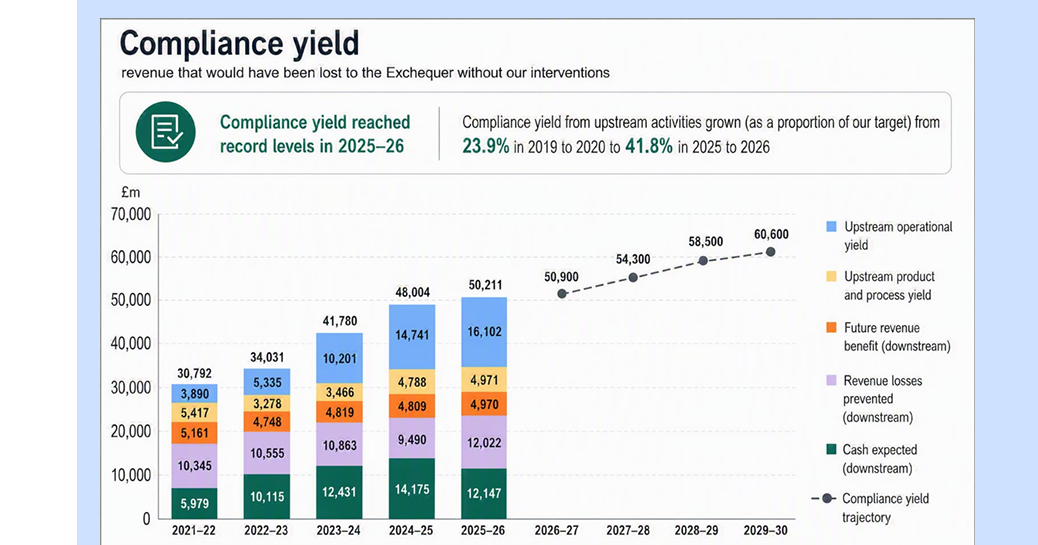
As you can see, it is helpfully split into five coloured blocks, the largest (the top one) being for £16.1 billion which is attributed to ‘Upstream operational yield’. What’s that, I hear you ask. Well, the small print under the chart helpfully explains “Upstream operational yield: estimated impact of operational activities undertaken to promote compliance and prevent non-compliance before it occurs.”
What this means is things like ‘nudge letters’, where HMRC writes out to various taxpayers in various businesses or sectors and tells them things that they should or should not do. They give an example on page 16 of the report where they are talking about modernisation and say:“…throughout 2025 to 2026, we worked with commercial software providers and agents to support 3.2 million small businesses to correctly claim business expenses by setting digital nudges that provided advice whilst the customer completed their return. This approach, alongside targeted communications to 1.2 million customers, led to more accurate reporting and brought in £36.4 million additional revenue in 2025 to 2026, with the full impact of around £250 million over five years.”
So, basically, they are estimating how much extra tax they’ve saved by telling taxpayers what they can claim. Isn’t that marvellous? To think that there were that many small businesses who were claiming expenses that they weren’t entitled to! Why, it’s almost akin to a bank installing a new alarm and telling the shareholders “we’ve saved £250 million over the next five years which is what we estimate bank robbers would have stolen from us if we hadn’t installed an alarm”.
But what’s the next block in that chart? It’s ‘Upstream product and process yield” at £4.9 billion. It is described as “estimated annual impact on net tax receipts of legislative changes to close tax loopholes and changes to our processes which reduce opportunities to avoid or evade tax”. So that’ll be legislation to stop tax avoidance and the like – in other words, another bank alarm system. Heck, these first two blocks of estimated savings ‘upstream’ make up over £21 billion of the claimed compliance yield of £50.2 billion – and, if you look at that chart again, they even boast about it at the top when they say “compliance yield from upstream activities [has] grown from 23.9% in 2019/2020 to 41.8% in 2025/2026”.
What about the rest of the claimed compliance yield? Well, the next two are (wait for it) ‘Downstream’ estimates. So the Future Revenue Benefit – another £4.9 billion – is described as the “estimated effect of our past compliance work on customers’ compliance in the current tax year”. (Translation – we put a sign up on the bank last year saying thieves would be prosecuted and we estimate that saved us billions.) The ‘Forecast losses prevented’ of £12 billion is described as “revenue that we prevented from being lost to the Exchequer through our compliance work, such as where a fraudulent or erroneous claim to a relief or repayment is either reduced or refused. It also recognises the estimated value of refused registrations, disruption of criminal activity and the revenue value of seized goods.” (Translation – we didn’t allow some people that we thought were crooks to open an account with the bank and it saved us a fortune).
Finally, we are left with a dark green block at the bottom which is valued at £12.1 billion and that is entitled ‘Cash expected’. It is described as “additional revenue due when we identify past non-compliance, with a reduction to reflect revenue that we estimate will not be collected”. So, eventually, that is the money they actually got in from investigating people and it is £2 billion less than the previous year – and not even as much as they got in during 2023/24. Hmmm, so maybe not quite as rosy as painted.
Let’s move on from the Compliance yield to reduction in the debt as a proportion of receipts, which they say has dropped to 4.7% from 5.0%. On page 24 of the report they say: “In 2025 to 2026, we resolved around £102 billion of debt.” Forgive me, but whenever I see some unusual phraseology – such as talk of a debt being ‘resolved’ – I become a little suspicious. What does this mean? Well, the report goes on to say that “a resolution is when a debt is concluded during the year, most commonly through payment or losses”. You have to go on another two pages to find out that “it’s not always possible to collect debts, and when we can’t, they become ‘tax losses’ – which can be classed as ‘write-offs’ or ‘remissions’”.
So, some of these debts are simply written off. And we have to go back to page 26 to work out how much was collected and how much written off and we see that “the vast majority, around 82%, of resolutions in 2025 to 2026 were due to the debt being paid”. They can’t actually bring themselves to say it but that seems to suggest that 18% of the debts – almost one-fifth – were written off. In that light, the reduction from 5% to 4.7% doesn’t seem quite so great.
Customer service ‘strides’
Okay, let’s look at customer service and those great strides in answering the telephone. Remember, the wait time used to be 18 minutes and 38 seconds and now it’s only 12 minutes and 35 seconds, and 85.1% of calls are answered when it used to be 71.5%. Again, there is a helpful chart – or rather, two helpful charts, side by side – on page 33 of the report. To make sense of this, you have to understand what they mean when they talk about the “proportion of adviser attempts handled”. The small print explains that this is “the proportion of callers who got through to an adviser after hearing the automated messages and choosing to speak to an adviser”. Here are the two charts:
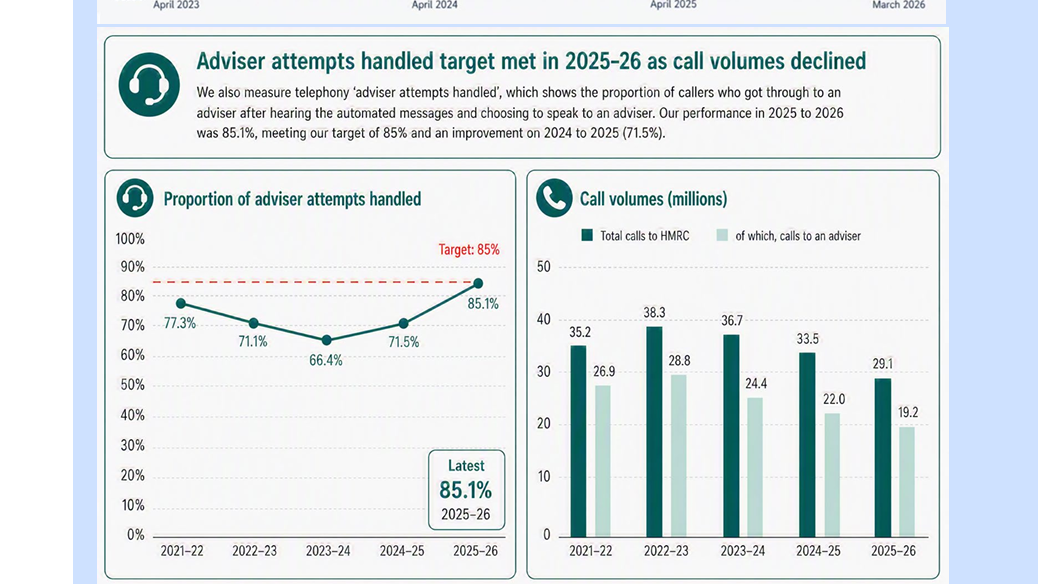
Yes, we can see that the proportion of callers who actually decided that they wanted to speak to someone and were successful in getting through to a human increased from 71.5% to 85.1%. But hold on a second – look at the number of callers. They seem to be steadily reducing, year upon year. Last year there were 33.5 million and HMRC answered 71.5%, and in 2025/26 the numbers dropped to 29.1 million and HMRC answered 85.1% of them.
I know what you are thinking. What does that actually mean in terms of calls answered by HMRC – and the answer is very little difference. You see, 71.5% of 33.5 million is just under 24 million and 85.1% of 29.1 million is 24.7 million – So, not much of an improvement really. The major cause of the improvement is because fewer and fewer people are calling HMRC. Could it possibly be because people know they’ll have to wait a very long time to get an answer? And let us not forget, there is a 15% slice of the population who hang on and hang on but don’t actually get their call answered at all. And 15% of 29.1 million means that there were over 4.3 million people who rang HMRC in 2025/26 and never got an answer.
One can continue on through the HMRC annual report and find the same kind of – how shall I phrase it? – sleight of hand again and again. The language used seems very much intended to obscure the underlying truths, be that by claims for ‘upstream’ compliance yields to debts being ‘resolved’, or telephone calls answered being referred to as ‘adviser attempts handled’. But dig deep enough and the answers are there, and soon that optimistic and positive Executive Summary starts to sound like an old joke.
And speaking of old jokes, let’s return to that cartoon in Punch magazine in 1895. It featured a bishop and a nervous young curate eating breakfast. The bishop points out that the boiled egg that the curate is eating is rotten and the curate, in his anxiety not to offend the bishop replies: “Oh no, my Lord, I assure you, parts of it are excellent!”
The cartoon, entitled ‘True Humility’, gave rise to the phrase ‘a curate’s egg’, meaning something that is both good and bad. In reality, of course, once you realise that parts of your boiled egg are rotten, the whole thing becomes very difficult to swallow – much like HMRC’s Annual Report.
• Tony Monger is a former HMRC Investigator and Investigation Team Leader